
Ever feel stuck wondering what skill to learn next to truly advance your career? It’s a common dilemma. You know you need to grow, but pinpointing the exact areas that will deliver the biggest impact can feel like guesswork. The truth is, without a clear understanding of where your current abilities stand against where you need to be, you’re just throwing darts in the dark. That’s why learning to effectively audit your own skill gaps is not just a good idea, it’s essential for strategic career progression.
This isn’t about aimlessly acquiring new certifications or following the latest trend. It’s about a deliberate, structured process to identify precisely what you need to develop. I’ve seen firsthand how a strategic approach transforms careers, moving professionals from feeling stagnant to confidently charting their next big move. Let’s explore the “Strategic Skill Gap Audit Framework,” a direct, actionable method designed to empower you to pinpoint and bridge those crucial gaps.

The Strategic Skill Gap Audit Framework: An Overview
The Strategic Skill Gap Audit Framework isn’t just another buzzword-laden methodology. It’s a pragmatic, five-step process designed to give you clarity and direction. Think of it as your personal GPS for professional development, helping you navigate the complex terrain of career growth. This framework is particularly powerful when you’re at a career crossroads, seeking a promotion, or simply feeling the need to stay competitive in the rapidly evolving global job market. For instance, the World Economic Forum’s Future of Jobs Report consistently highlights the dynamic nature of in-demand skills, underscoring the constant need for proactive skill auditing.
You can apply this framework whether you’re an individual contributor aiming for senior specialist roles or a budding leader preparing for management. It forces you to look beyond superficial desires and dig into the core competencies that will genuinely propel you forward. Let’s break down each step.
Step 1: Define Your North Star (Where Are You Going?)
Identify Your Target Role or Career Trajectory
Before you can identify any gaps, you must know what you’re aiming for. This isn’t just about a job title; it’s about the responsibilities, the impact you want to make, and the environment you thrive in. Be specific. Are you aiming for a senior leadership position, a principal engineer role, or perhaps a pivot into product management? Your “North Star” provides the context for every subsequent step in your skill audit.
Start by researching roles that excite you. Look at job descriptions for positions you aspire to hold in 3-5 years. What are the common threads? What skills, experiences, and qualifications do they repeatedly list? Don’t just skim; analyze them deeply. This clarity helps you avoid wasting time on irrelevant skill development.
Example: The Aspiring Engineering Manager
Let’s say you’re a senior software engineer. Your North Star is to become an Engineering Manager. You’ve researched several job descriptions and talked to current engineering managers. You’ve identified that this role requires strong technical leadership, team management, project planning, mentoring, conflict resolution, and strategic communication with stakeholders. This detailed picture of the target role is crucial to accurately decide on the management track and define the skills you’ll need to develop.
Step 2: Inventory Your Current Arsenal (Where Are You Now?)
Conduct a Comprehensive Self-Assessment
Now, take an honest look in the mirror. What skills do you currently possess? This isn’t a bragging session; it’s a realistic evaluation of your strengths and weaknesses. Categorize your skills: technical (e.g., Python, cloud architecture), soft skills (e.g., communication, problem-solving), and domain-specific knowledge (e.g., FinTech regulations, healthcare compliance).
Don’t just list skills; rate your proficiency. Use a simple scale: Beginner, Intermediate, Proficient, Expert. Provide concrete examples for each skill to back up your rating. Where have you applied this skill successfully? What was the outcome? This evidence-based approach makes your inventory far more valuable than a simple checklist.
Example: Engineering Manager Candidate’s Current Skills
Our aspiring Engineering Manager might list:
- Technical Skills: Python (Expert – led multiple projects), AWS (Proficient – designed scalable solutions), Docker (Intermediate – used in personal projects).
- Soft Skills: Problem-solving (Expert – debugged critical production issues), Mentoring (Intermediate – informally mentored junior engineers), Project Planning (Beginner – contributed to project plans, but never owned one end-to-end), Conflict Resolution (Beginner – avoided direct conflict, deferred to leads).
- Domain Knowledge: E-commerce platforms (Proficient).
This inventory provides a baseline, a snapshot of your current capabilities. It’s not just about listing what you can do, but how well you do it, and in what context.
Step 3: Identify the Discrepancy (What’s Missing?)
Compare Your North Star to Your Current Arsenal
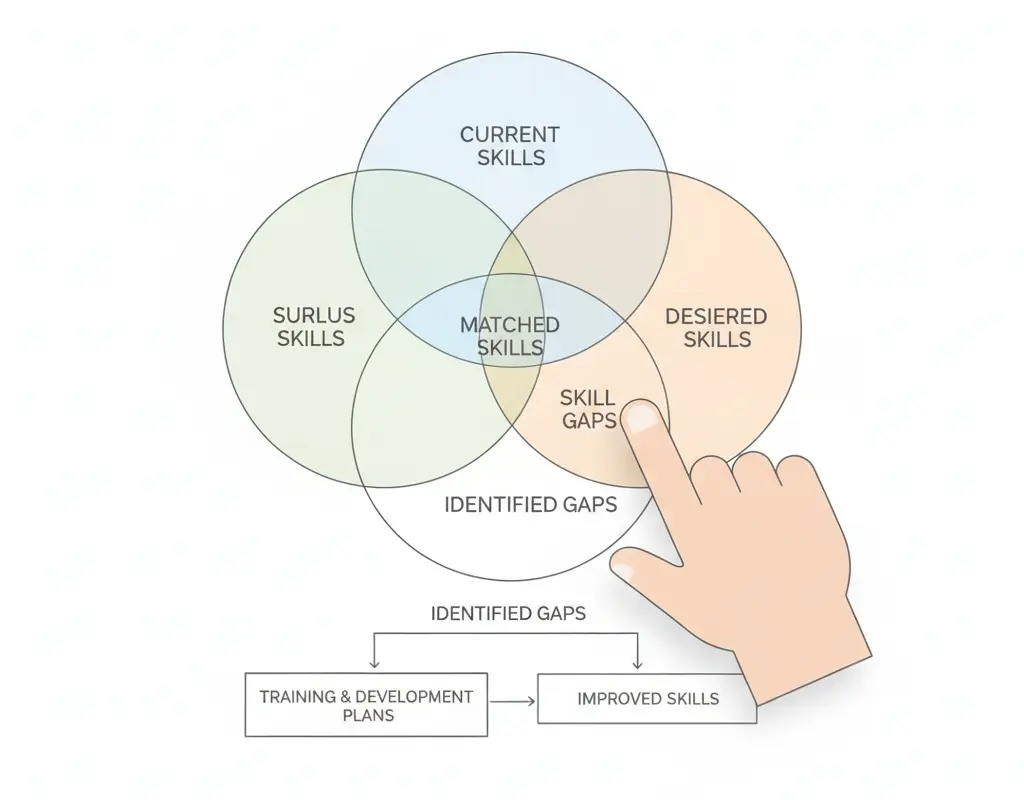
With your target role clearly defined and your current skills inventoried, the next step is to overlay them. This is where the “gap” truly emerges. Go through the list of skills required for your North Star role and compare it, point by point, with your current proficiencies. Where are the significant differences?
Look for two types of gaps:
- Missing Skills: Skills required for the target role that you simply don’t have at all.
- Proficiency Gaps: Skills you possess, but not at the level required for the target role. For instance, you might have “communication” but lack the “strategic communication with senior stakeholders” needed for a leadership role.
Be brutally honest here. This isn’t a judgment; it’s an assessment. The clearer you are about these discrepancies, the more effective your development plan will be. This step helps you understand the specific areas where you need to grow, providing tangible targets for improvement.
Example: Pinpointing Gaps for the Aspiring Engineering Manager
Comparing the target Engineering Manager role requirements to the current skills:
- Missing Skills: Budget management, Performance review processes, Cross-functional team leadership.
- Proficiency Gaps:
- Technical Leadership: Needs to move from “leading projects” to “guiding architectural decisions across teams.”
- Team Management: Needs formal experience, not just informal mentoring.
- Project Planning: Needs to move from “contributing” to “owning and driving.”
- Conflict Resolution: Needs to move from “avoiding” to “proactively mediating and resolving.” This is a critical quality of a good manager, so it’s a significant gap.
- Strategic Communication: Needs development in communicating with executive stakeholders.
These identified gaps are your raw material for the next step. They represent the specific learning objectives you need to address.
Step 4: Prioritize for Impact (What Matters Most?)
Focus on High-Leverage Skills
You’ll likely find a long list of gaps. Trying to tackle everything at once is a recipe for burnout and minimal progress. This step is about strategic prioritization. Which gaps, if closed, would give you the biggest return on investment for your North Star? Consider these factors:
- Impact: Which skills are absolutely critical for the target role? Without them, could you even perform the job?
- Feasibility: Which skills can you realistically develop in a reasonable timeframe given your resources (time, money, access to learning)?
- Urgency: Are there skills that are becoming obsolete or are immediately needed for an upcoming opportunity?
- Interest: While not purely objective, prioritizing skills you’re genuinely interested in learning increases your motivation and likelihood of success.
Don’t just randomly pick. Rank your identified gaps based on a combination of these factors. Aim for 2-3 core skills to focus on in the short to medium term (e.g., next 6-12 months). This focused approach ensures meaningful progress.
Example: Prioritizing Gaps for the Aspiring Engineering Manager
Our candidate reviews their gaps and prioritizes:
- High Priority: Project Planning (owning end-to-end), Team Management (formal leadership experience), Conflict Resolution (proactive mediation). These are foundational for any management role.
- Medium Priority: Strategic Communication (with stakeholders), Technical Leadership (architectural guidance). These are important but can be developed concurrently or slightly later.
- Lower Priority: Budget Management, Performance Review Processes. While necessary, these can often be learned on the job or through specific training once the core management skills are in place.
By prioritizing, the candidate avoids overwhelming themselves and focuses their energy on the most critical development areas first. This also helps in building a stronger personal brand for mid-career professionals, as it showcases intentional growth.
Step 5: Build Your Development Roadmap (How Will You Get There?)
Create an Actionable Plan
This is where theory meets practice. For each prioritized skill gap, outline concrete steps you’ll take to close it. Think about different learning modalities:
- Formal Learning: Online courses (Coursera, LinkedIn Learning), certifications, workshops, degree programs.
- Experiential Learning: Volunteering for projects that require the skill, taking on new responsibilities, shadowing someone proficient, seeking stretch assignments.
- Mentorship/Coaching: Finding someone who excels in that skill to guide you, provide feedback, and offer insights.
- Self-Study: Reading books, articles, practicing independently.
For each action, set a timeline and define how you’ll measure success. What does “proficient” look like for this specific skill? How will you know you’ve closed the gap? Regular check-ins and adjustments are crucial. This roadmap isn’t static; it’s a living document.
Example: Roadmap for the Aspiring Engineering Manager
For “Project Planning (owning end-to-end)”:
- Action 1: Enroll in an online project management course (e.g., Agile Project Management specialization). Deadline: 3 months.
- Action 2: Volunteer to lead a small, non-critical internal project from inception to completion. Deadline: 6 months.
- Action 3: Seek mentorship from an experienced Project Manager or Engineering Manager. Ongoing.
- Success Metric: Successfully deliver a project, receiving positive feedback on planning and execution from stakeholders.
For “Conflict Resolution (proactive mediation)”:
- Action 1: Read “Crucial Conversations” and practice techniques in low-stakes situations. Deadline: 2 months.
- Action 2: Shadow a team lead or manager during a conflict resolution discussion (if appropriate and approved). Deadline: 4 months.
- Success Metric: Confidently facilitate a team discussion where different viewpoints are present, leading to a constructive outcome.
A Worked Example: The Aspiring Product Manager
Let’s consider a senior UX Designer, Alex, who wants to transition into a Product Manager role.
Step 1: Define North Star (Product Manager)
Alex researches PM roles: Requires market analysis, business strategy, technical understanding, stakeholder management, roadmap ownership, data analysis, user empathy (already strong from UX). Key shift: from “how it looks/feels” to “what to build and why.”
Step 2: Inventory Current Arsenal (Senior UX Designer)
Alex lists: User Research (Expert), Prototyping (Expert), Design Thinking (Expert), User Empathy (Expert), UI/UX Software (Expert), Team Collaboration (Proficient), Presentation Skills (Proficient). Business Acumen (Beginner), Data Analysis (Beginner), Technical Feasibility Assessment (Beginner).
Step 3: Identify Discrepancy
- Missing Skills: Pricing strategy, Go-to-market planning, A/B testing strategy, SQL for data analysis.
- Proficiency Gaps:
- Business Acumen: Needs to move from basic understanding to strategic decision-making.
- Technical Feasibility: Needs to move from understanding design constraints to understanding engineering effort and system architecture.
- Data Analysis: Needs to move from interpreting UX metrics to driving product decisions from quantitative data.
- Stakeholder Management: Needs to move from collaborating with engineers/designers to influencing executives and sales teams.
Step 4: Prioritize for Impact
Alex prioritizes: Data Analysis (critical for decision-making), Business Acumen (to inform strategy), Technical Feasibility (to work effectively with engineering), and Stakeholder Management (to drive alignment).
Step 5: Build Development Roadmap
- Data Analysis: Enroll in a SQL for Product Managers course (2 months). Take on a project to analyze feature usage data using SQL (3 months).
- Business Acumen: Read “Lean Startup,” “Inspired,” and “Crossing the Chasm” (3 months). Shadow a product marketing manager for a week (if possible).
- Technical Feasibility: Schedule regular 1:1s with engineering leads to understand system architecture and development processes (ongoing). Volunteer for a project requiring close technical collaboration.
- Stakeholder Management: Proactively lead cross-functional meetings for current UX projects, practicing influencing skills (ongoing). Seek feedback from senior PMs on communication style.
This structured approach helps Alex systematically address key areas, making the transition less daunting and more achievable.
Adapting the Framework for Your Career Stage
The Strategic Skill Gap Audit Framework is flexible. Its core principles apply whether you’re early in your career, a mid-career professional, or a seasoned executive. The difference lies in the scope and nuance of each step.
- Early Career: Your North Star might be a specific senior individual contributor role. Your inventory focuses heavily on foundational technical and soft skills. Gaps might be broader, requiring more formal learning.
- Mid-Career: Your North Star often involves leadership, specialization, or strategic influence. Your inventory includes a mix of proven skills and emerging areas. Gaps are often more nuanced—moving from “doing” to “leading” or “strategizing.” This is where you might critically assess if you are ready to move into a leadership role, and what specific skills are needed.
- Executive Level: Your North Star is about organizational impact, vision setting, and complex problem-solving. Your inventory leans heavily into strategic thinking, executive presence, and influencing across the organization. Gaps might be in emerging technologies, global market understanding, or advanced change management. Development often involves executive coaching, board roles, or strategic advisory positions.
Regardless of your stage, the principle remains: define where you’re going, assess where you are, identify the delta, prioritize, and plan your journey. The depth of analysis and the types of resources you tap into will naturally evolve with your experience.
Conclusion
Mastering the ability to audit your own skill gaps is a game-changer for your career. It shifts you from reactive learning to proactive, strategic development. By diligently defining your North Star, honestly inventorying your current abilities, pinpointing the precise discrepancies, prioritizing for maximum impact, and building a clear development roadmap, you take control of your professional trajectory.
Don’t leave your career growth to chance. Take the time to apply this framework to your own situation. The clarity you gain will empower you to make informed decisions about your learning journey, ensuring every effort you put in moves you closer to your ultimate career goals. Ready to put this framework into action? Download our comprehensive “Strategic Skill Gap Audit Checklist” to guide you through each step and start building your future, today.