
Are you a mid-career professional feeling a bit adrift, knowing you want more but unsure how to get there? Perhaps you’ve tried setting career goals before, only to see them fizzle out. It’s a common challenge: the professional landscape shifts constantly, and what worked in your early career might not cut it now. You need a robust, adaptable approach to truly drive your growth.
That’s precisely why we developed the ALIGN career goal setting framework. This isn’t just another checklist; it’s a strategic, step-by-step methodology designed to help experienced professionals like you clarify your aspirations, identify the right path forward, and build momentum toward meaningful career success. Whether you’re eyeing a promotion, a pivot, or simply a clearer sense of purpose, ALIGN provides the structure you need to move from ambition to achievement.

Why a Framework? The Mid-Career Maze
As you advance in your career, the path often becomes less linear. The clear-cut milestones of earlier stages—entry-level job, first promotion—give way to a more complex interplay of skills, aspirations, and market realities. Without a structured approach, it’s easy to get stuck in a holding pattern, or worse, to chase goals that don’t truly resonate with your long-term vision.
Many mid-career professionals grapple with a sense of stagnation or uncertainty. They might be high performers, yet feel overlooked for leadership roles or struggle to articulate their next big move. A dedicated career goal setting framework helps cut through this noise, providing clarity and direction when you need it most. It’s about intentional growth, not accidental progress.
Introducing the ALIGN Framework for Career Goal Setting
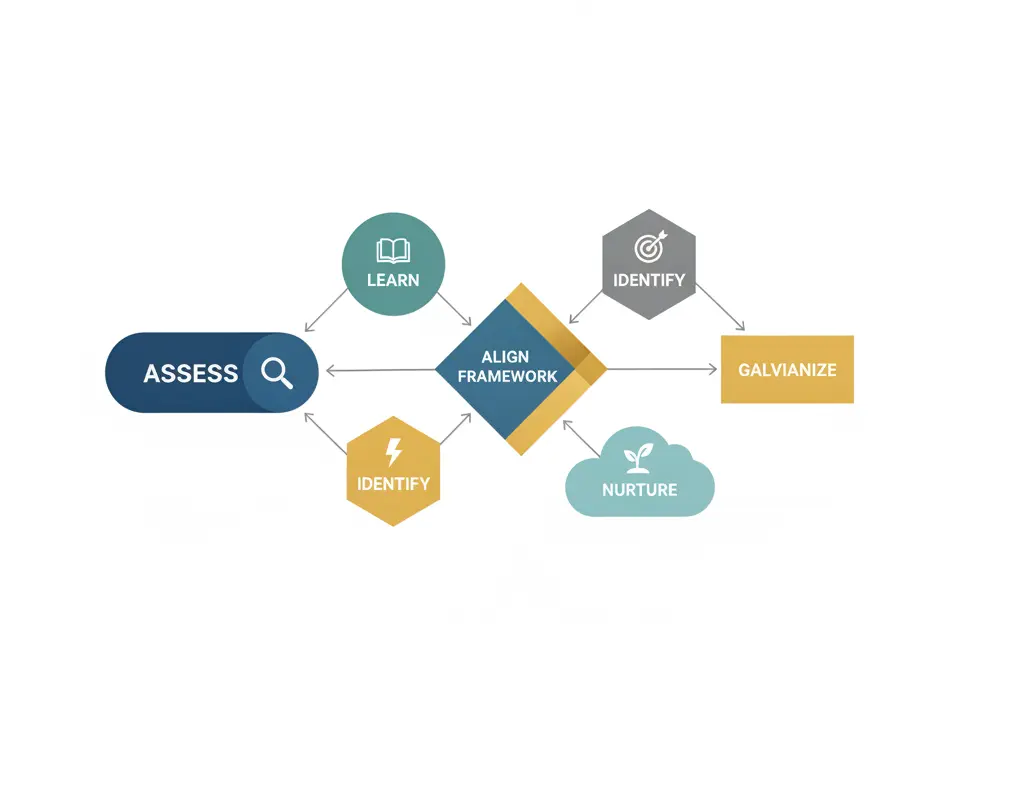
The ALIGN framework is built on five core principles, each designed to systematically guide you through the process of defining and achieving your career aspirations. It’s a dynamic cycle, not a one-time event, encouraging continuous reflection and adaptation. Here’s what each step entails:
A: Assess Your Current Reality
Before you can chart a new course, you need to understand where you currently stand. This isn’t just about your job title or salary; it’s a holistic evaluation of your skills, strengths, weaknesses, passions, and current professional environment. What do you excel at? What drains your energy? What market trends are impacting your industry? Be brutally honest in this self-assessment.
- Skills Audit: What hard and soft skills do you possess? Which are highly valued, and which need development? Consider conducting a thorough audit of your own skill gaps for career growth to identify areas for improvement.
- Performance Review: Objectively review past performance feedback. What are recurring themes? Where have you consistently exceeded expectations, and where have you fallen short?
- Market Scan: Research your industry. What are the emerging roles, in-demand skills, and growth sectors? Look at job descriptions for positions you aspire to.
- Personal Fulfillment: Beyond the professional, what aspects of your current role or company truly fulfill you? What leaves you feeling uninspired?
Example: Sarah, a marketing manager, feels stuck. Her assessment reveals she excels at strategic planning but dislikes day-to-day campaign execution. She also notices a growing industry demand for data-driven marketing leaders, a skill she currently lacks.
L: Learn & Develop Essential Skills
Once you’ve assessed your gaps and identified areas for growth, the next step is to actively learn and develop the skills required for your desired future. This might involve formal education, certifications, online courses, or hands-on project experience. The key is to be strategic about your learning, focusing on skills that directly support your career goals.
- Targeted Learning: Based on your assessment, pinpoint 1-3 critical skills. For instance, if you aim for a leadership role, focus on executive communication or strategic thinking. Sometimes, the challenge is simply knowing what skill to learn next for career growth.
- Experiential Growth: Seek out projects or tasks that allow you to practice these new skills. Volunteer for cross-functional initiatives or offer to mentor junior colleagues.
- Mentorship & Coaching: Connect with individuals who possess the skills you want to develop. Their insights and guidance can be invaluable.
Example: Building on her assessment, Sarah enrolls in an online course on advanced data analytics for marketing. She also volunteers to lead a cross-departmental project focused on optimizing marketing ROI, gaining practical experience in data interpretation and presentation.
I: Identify Your Core Values & Vision
This is where you connect your career to your deepest sense of purpose. What truly matters to you? What impact do you want to make? Identifying your core values and crafting a compelling vision for your future career helps ensure that your goals are intrinsically motivating and sustainable. Without this internal compass, even well-intentioned goals can feel hollow.
- Value Clarification: List your top 5 personal and professional values (e.g., autonomy, impact, creativity, security, growth). How do these align with your current role and future aspirations?
- Vision Statement: Draft a concise, inspiring statement describing your ideal career future in 3-5 years. What does it look like, feel like, and what are you achieving?
- Purpose Alignment: How does your work contribute to something bigger than yourself? Understanding your unique purpose can be a powerful motivator.
Example: Sarah realizes her core values are innovation and mentorship. Her vision is to lead a high-performing, data-driven marketing team that fosters creative problem-solving and develops future talent. This clarity helps her prioritize opportunities.
G: Galvanize Action & Build Your Plan
A vision without a plan is just a dream. This step is about translating your insights and aspirations into concrete, actionable steps. Break down your larger goals into smaller, manageable tasks with deadlines. Who needs to be involved? What resources do you need? This is where you build your roadmap to success.
- SMART Goals: Ensure your goals are Specific, Measurable, Achievable, Relevant, and Time-bound. For instance, instead of “get promoted,” aim for “secure a Senior Marketing Director role within 18 months by leading two successful strategic initiatives and expanding my data analytics expertise.”
- Action Plan: Create a detailed timeline of tasks, milestones, and deadlines. Who will you talk to? What will you create? What skills will you apply?
- Anticipate Obstacles: Think about potential roadblocks and proactively strategize how to overcome them. Consider alternative paths if your initial plan hits a snag.
- Market Opportunities: Keep an eye on the broader job market. For instance, the U.S. Bureau of Labor Statistics Occupational Outlook Handbook offers valuable insights into future job growth and industry trends, which can inform your strategic planning.
Example: Sarah’s plan includes completing her data analytics course in 3 months, scheduling monthly check-ins with her mentor, and targeting two specific strategic projects at work over the next year to demonstrate her leadership and data skills. She sets a goal to apply for Senior Marketing Director roles internally and externally within 12-18 months.
N: Nurture Your Network & Sustain Momentum
Career growth is rarely a solo journey. Building and nurturing a strong professional network is crucial for opportunities, mentorship, and support. Furthermore, sustaining momentum requires ongoing effort, accountability, and a willingness to adapt. This final step ensures you stay connected, motivated, and on track.
- Strategic Networking: Identify key individuals who can support your goals—mentors, sponsors, industry peers. Don’t just collect contacts; cultivate genuine relationships. Attend relevant industry events and engage thoughtfully on professional platforms.
- Accountability Partners: Share your goals with a trusted colleague, mentor, or friend. Regular check-ins can provide motivation and help you stay committed.
- Continuous Feedback: Actively seek feedback on your progress and performance. Be open to constructive criticism and use it to refine your approach.
- Celebrate & Adjust: Acknowledge your small wins to maintain motivation. Equally important, be prepared to adjust your plan as circumstances change or new opportunities arise. Your career path isn’t set in stone; it’s a living document.
Example: Sarah regularly connects with her mentor for advice on leadership challenges and leverages her expanding network to learn about potential Senior Director openings. She joins a local marketing leadership forum, expanding her professional circle and gaining new perspectives. She also sets aside dedicated time each week to review her progress and adjust her action plan as needed.
Putting ALIGN into Practice: A Case Study
Let’s follow Mark, a mid-career software engineer who felt his career had plateaued. He enjoyed coding but wanted more strategic influence.
- A (Assess): Mark realized he loved problem-solving and mentoring junior engineers but felt stifled by purely technical tasks. He observed a growing need for technical architects who could bridge engineering and business strategy.
- L (Learn): He identified a gap in his understanding of enterprise architecture and business analysis. He enrolled in an online certification for cloud architecture and began taking on small, cross-functional projects that required him to translate technical concepts for non-technical stakeholders. This strategic learning helped him future-proof his career without guessing.
- I (Identify): Mark’s core values were impact and intellectual challenge. His vision was to lead architectural initiatives that directly shaped product direction and fostered innovation within his company.
- G (Galvanize): He set a SMART goal: become a Lead Solutions Architect within 2 years by completing his certification, successfully designing and implementing a new microservices architecture for a key product, and presenting his work to senior leadership. He broke this down into quarterly milestones, including networking with existing architects and practicing presentation skills.
- N (Nurture): Mark sought out a senior architect as a mentor, regularly meeting to discuss challenges and gain insights. He also started a small internal tech-talk series, showcasing his expertise and building his personal brand within the company. He actively engaged with his peers and sought feedback on his architectural designs.
Within 18 months, Mark successfully transitioned into a Lead Solutions Architect role, demonstrating how the ALIGN framework provides a clear roadmap for intentional career progression.
Adapting ALIGN for Different Stages
The beauty of the ALIGN framework is its flexibility. While designed for mid-career professionals, its principles can be adapted to various stages and aspirations:
- For Leadership Aspirations: Focus your ‘Learn’ phase on leadership development, executive presence, and strategic thinking. In ‘Galvanize,’ target specific leadership projects. If you’re feeling stuck on the path to senior roles, understanding this framework can be a powerful tool for those asking how to get promoted at mid-career when you feel stuck.
- For Career Pivots: Your ‘Assess’ phase will be broader, exploring transferable skills and new industry research. ‘Learn’ will involve acquiring entirely new competencies, and ‘Nurture’ will heavily emphasize building a network in your target industry.
- For Entrepreneurial Ventures: The framework still applies, but your ‘Identify’ will focus on market gaps and business vision, and ‘Galvanize’ will involve business planning and fundraising.
Regardless of your specific goal, the systematic approach of ALIGN provides a sturdy scaffold upon which to build your future.
Conclusion
Navigating your mid-career journey doesn’t have to be a guessing game. The ALIGN career goal setting framework offers a powerful, practical method to bring clarity, purpose, and actionable steps to your professional aspirations. By systematically Assessing your reality, Learning essential skills, Identifying your core values, Galvanizing action, and Nurturing your network, you can build a career that is not only successful but also deeply fulfilling.
Don’t let uncertainty dictate your next move. Take control of your career trajectory with ALIGN. Ready to put this framework into action? Download our free ALIGN Framework Checklist to start defining your next chapter today and transform your career goals into tangible achievements.