
You’re at a crossroads in your career, aren’t you? That familiar ping of an internal job posting for a “Team Lead” or “Manager” role lands in your inbox, and suddenly you’re grappling with a significant question. For many individual contributors (ICs), the path to management feels like the natural next step, the only way up. But what if it’s not? What if the leadership path you’re envisioning isn’t quite the right fit for your unique strengths and aspirations? This moment, this specific problem of navigating the individual contributor to manager transition, is precisely why we need a structured approach. It’s about more than just a title; it’s about finding where you can make the most impact and truly thrive.
This post introduces The Clarity Path Framework – a practical, step-by-step decision tool designed to help you, as an experienced individual contributor, thoughtfully evaluate whether the management track is genuinely aligned with your career goals, or if doubling down on your IC expertise offers a more fulfilling and impactful future. We’ll strip away the assumptions and societal pressures, and give you the tools to make an informed choice that’s right for you, whether you’re contemplating becoming a manager for the first time or just exploring your next career move.

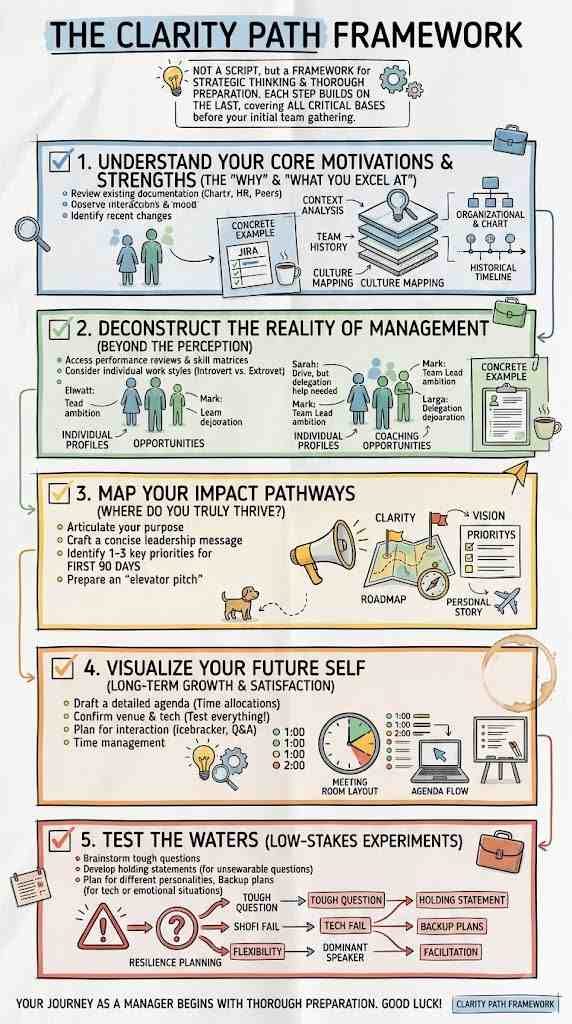
The Clarity Path Framework: Your Guide to Intentional Career Decisions
The Clarity Path Framework isn’t about telling you which decision to make. Instead, it equips you with the lens to see both paths – continued individual contribution and the management track – with clear eyes. It’s particularly useful when you’re feeling the pull towards leadership but aren’t quite sure if it’s “your” kind of leadership, or if you’re truly ready for the shift from doing the work to enabling others to do the work. Let’s break down each step.
Step 1: Understand Your Core Motivations & Strengths (The “Why” & “What You Excel At”)
Before you look outward, look inward. What truly energizes you? What problems do you love solving? What skills do you possess that you genuinely enjoy using day-to-day? This isn’t about what you’re good at in a general sense, but what brings you a sense of accomplishment and flow. Gallup’s extensive research on strengths-based development consistently shows that aligning your work with your natural talents leads to higher engagement and performance.
Concrete Example: Imagine you’re a Senior UX Designer, “Priya.” You’re incredibly skilled at user research, crafting intuitive interfaces, and solving complex user experience challenges. You get a real buzz from iterating on designs, seeing a product come to life, and directly impacting user satisfaction. You also enjoy mentoring junior designers one-on-one, offering constructive feedback on their specific projects. However, you find administrative tasks like scheduling, budget management, and mediating team conflicts draining. Your core motivation is solving design problems directly and creating beautiful, functional products. Your strength is hands-on design expertise and technical mentorship, not necessarily broad team management or operational oversight.
Step 2: Deconstruct the Reality of Management (Beyond the Perception)
What do you “think” management entails? Now, challenge that perception. Many individual contributors envision management as being the “idea person,” the strategic visionary, or the one who gets to dictate the direction. While those elements can exist, the day-to-day reality of management, especially for those moving from individual contributor to leadership, is often far different. It involves significant amounts of time on operational tasks, people development, conflict resolution, performance management, and acting as a buffer between your team and external pressures. Harvard Business Review frequently publishes articles on the challenges of new managers, highlighting that the biggest surprise is often the sheer amount of time spent on “people problems” rather than “technical problems.”
Concrete Example: Let’s continue with Priya. She might envision a UX Manager role as leading innovative design initiatives and having the final say on product aesthetics. The reality for the UX Manager at her company, “Mark,” involves 30% of his time in one-on-one performance reviews, 20% mediating disputes between designers and developers, 15% managing vendor contracts for design tools, 15% reporting team progress to senior leadership, and only about 20% on strategic design direction, which he delegates heavily to his senior ICs. He rarely gets to do hands-on design himself. Priya needs to honestly ask herself: Is dealing with budget spreadsheets, HR issues, and conflict resolution what she truly wants to spend the majority of her day doing?
Step 3: Map Your Impact Pathways (Where Do You Truly Thrive?)
Impact isn’t solely defined by managing people. You can create immense value and influence as an individual contributor. This step is about identifying the different ways you can drive change and contribute significantly within your organization, or even your industry, without necessarily holding a management title. SHRM identifies various career paths beyond the traditional ladder, emphasizing depth of expertise as a powerful form of leadership.
Concrete Example: Priya considers her impact. As a Senior UX Designer, she can:
- IC Path Impact: Drive major product initiatives, establish new design system standards, mentor junior designers through specific project guidance, lead complex user research efforts, or become a principal designer who influences product strategy through deep expertise. Her impact is direct, tangible, and tied to her craft.
- Manager Path Impact: Build and scale a high-performing design team, foster a positive team culture, advocate for design within the organization, manage resource allocation, or influence broader organizational strategy through her team’s output. Her impact is indirect, through the success of others.
Which pathway genuinely excites her more? Where does she feel she can make the most unique and valuable contribution?
Step 4: Visualize Your Future Self (Long-Term Growth & Satisfaction)
Fast forward five to ten years. What does a successful, fulfilling career look like for you on both paths? This isn’t just about job titles or salary, but about your daily activities, your level of autonomy, the kind of problems you solve, and the personal satisfaction you derive from your work. The Center for Creative Leadership (CCL) stresses the importance of understanding personal values and long-term aspirations in leadership development.
Concrete Example: For Priya:
- Future IC Self: She envisions herself as a “Principal UX Architect,” a recognized expert in her field, leading challenging, ambiguous projects, maybe even speaking at industry conferences. She’s continually learning new design methodologies and technologies, and her days are filled with creative problem-solving and hands-on design work. She mentors many, but manages none directly.
- Future Manager Self: She sees herself as a “Director of Product Design,” overseeing multiple teams, setting a broad vision, and empowering other managers. Her days involve strategic planning, stakeholder management, and talent development. She’s less involved in the actual design execution but is critical in shaping the overall product organization.
Which vision brings a deeper sense of contentment and purpose? Which aligns more closely with her intrinsic definition of success?
Step 5: Test the Waters (Low-Stakes Experiments)
Before making a definitive leap, find ways to “try on” aspects of the management role. This allows you to gain real-world insight without committing to a full role change. This experiential learning is crucial for validating your assumptions from Step 2.
Concrete Example: Priya decides to:
- Volunteer to formally mentor two junior designers for six months, focusing not just on design feedback but also on their career development and goal setting.
- Lead a cross-functional project where she’s responsible for coordinating efforts across different teams, managing timelines, and facilitating communication, but without direct report authority.
- Shadow her manager, Mark, for a few hours each week, specifically observing how he handles conflict, delegates tasks, and conducts performance reviews.
These experiments will give her firsthand experience with the “people-centric” aspects of management and help her confirm or refute her earlier assumptions about whether this work truly excites or drains her. Many individuals realize after these experiments that while they love leadership, they prefer technical leadership or thought leadership over people management.
Worked Example: Alex, the Data Scientist’s Clarity Path
Let’s follow “Alex,” a Senior Data Scientist known for his brilliant algorithmic solutions and deep analytical skills, who’s been tapped for a Data Science Lead role. He’s intrigued but apprehensive. He uses The Clarity Path Framework:
- Motivations & Strengths: Alex loves diving deep into data, building complex models, and solving challenging statistical problems. He thrives on intellectual puzzles and direct impact through his code. He enjoys teaching others complex concepts but isn’t keen on managing their personal development plans or mediating team disagreements.
- Reality of Management: He speaks to his current manager and others in lead roles. He learns the Data Science Lead spends 40% of their time on hiring, 30% on project allocation and conflict resolution, 20% on stakeholder communication, and only 10% on technical oversight or hands-on work. This is a stark contrast to his perception of being the “chief scientist.”
- Impact Pathways: As an IC, Alex can become a Principal Data Scientist, creating company-defining algorithms, driving innovative research, or building internal tools that empower multiple teams. As a manager, his impact would be through scaling the data science team’s output and improving processes. He realizes his greatest unique value lies in deep, technical problem-solving.
- Future Self: Alex envisions himself as a recognized expert, a “data guru” who can tackle any analytical challenge, continuously learning and pushing the boundaries of what’s possible with data. The idea of being a manager whose primary job is managing people rather than data doesn’t resonate with his long-term vision of intellectual fulfillment.
- Test the Waters: He volunteers to lead a specific, complex data modeling project involving three other data scientists, taking responsibility for the technical direction and mentorship, but not their performance reviews or HR issues. He also offers to onboard new hires, teaching them technical skills. Through this, he confirms he loves the technical leadership aspect, but the administrative burden he observed in Step 2 is not for him.
Alex’s Decision: He decides to decline the Data Science Lead role. Instead, he proposes a new “Principal Data Scientist” track, focusing on advanced research, mentorship, and highly complex projects, still influencing strategy through his deep technical contributions. He is happy to lead technical initiatives but not people. His company, valuing his unique skills, is open to exploring this alternative track, realizing the immense value of keeping top ICs engaged.
Adapting The Framework to Your Journey
The Clarity Path Framework is flexible. If you’re an early-career IC, your “Future Self” visualization might be less defined, and your “Test the Waters” steps might be smaller, like leading a task force for a week. For a senior IC contemplating a more strategic management role, your “Reality Check” might involve deeper dives into organizational politics and cross-functional leadership, and your “Impact Pathways” will consider broader business influence.
Regardless of your seniority, the core process remains invaluable: self-reflection, challenging assumptions, identifying diverse forms of impact, long-term visioning, and pragmatic experimentation. This framework isn’t just about the individual contributor to manager transition; it’s about making any significant career decision with greater intention and clarity.
Choosing your path – whether it’s continuing to hone your craft as an exceptional individual contributor or taking the leap into people management – is one of the most significant decisions you’ll make. It’s not about which path is “better,” but which path is better for you. By applying The Clarity Path Framework, you move beyond mere speculation and into an informed, confident choice that aligns with your true ambitions and strengths. Remember, leadership isn’t just about managing people; it’s about influence, impact, and making a difference, which you can absolutely do in a variety of roles.
Ready to apply The Clarity Path Framework to your own career? Download our comprehensive checklist and worksheet to guide you through each step, ensuring you consider every angle before making your next big move!