
You’ve been mastering your craft, delivering excellent results, and making significant contributions as an individual contributor. Now, you might be feeling a familiar tug—a desire for more, a sense that your impact could stretch further. This feeling is a natural precursor to the exciting, challenging journey of moving from individual contributor to leadership. It’s a pivotal career shift that many high-performers contemplate, often wondering, “Am I truly ready for this?” If you’re navigating the path of becoming a manager for the first time, recognizing the signs within yourself is the first, crucial step. This post isn’t about telling you what you *should* do, but helping you identify if you’re already demonstrating the traits that make a successful leader.
The Shifting Landscape: Why This Transition Matters
The jump from an individual contributor (IC) role to a management position is one of the most significant career transitions you’ll ever make. It fundamentally changes the nature of your work: from focusing primarily on your own deliverables to enabling the success of an entire team. This isn’t merely a promotion; it’s a redefinition of your purpose and impact. Many talented ICs struggle because they continue to operate with an IC mindset, trying to “do” everything themselves rather than empowering others. The challenge, and the opportunity, lies in shifting your perspective. As research from the Harvard Business Review frequently highlights, successful first-time managers pivot from being technical experts to people developers, prioritizing influence over individual output. Recognizing your readiness now can save you, and your future team, a lot of growing pains, making your transition into a leadership role smoother and more effective. It’s about more than just technical skill; it’s about a fundamental shift in your professional identity.
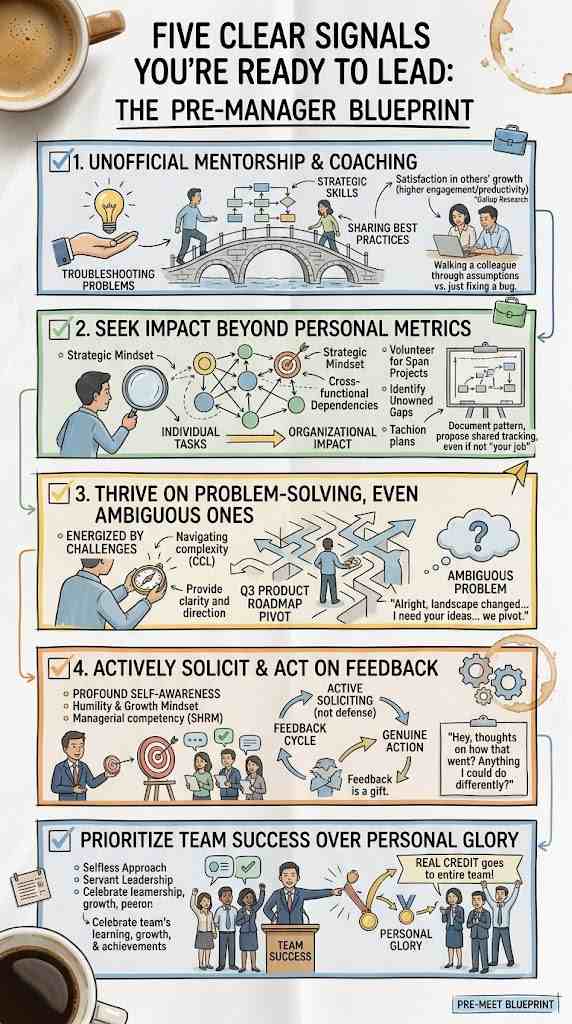
Five Clear Signals You’re Ready to Lead
If you’re asking “how to know if you want to be a manager,” look for these five powerful indicators. They reveal a deeper alignment with leadership principles than just a desire for a title.
You’re Already Mentoring or Coaching Others Unofficially
You find yourself naturally helping colleagues troubleshoot problems, offering advice on how to approach a new task, or sharing best practices without being asked. This isn’t just about being helpful; it’s about finding satisfaction in enabling others’ growth and success. You’re not just giving answers; you’re guiding them to find their own solutions, fostering their capabilities. This informal mentorship is a cornerstone of effective leadership. Gallup’s research consistently shows that managers who focus on developing their team members’ strengths see higher engagement and productivity.
Example/Script: Imagine a junior colleague is stuck on a coding bug or a complex report. Instead of just fixing it for them, you sit down and say: “Walk me through what you’ve tried so far. What are your assumptions? Sometimes just talking it out helps. Have you considered looking at the data from a different angle, like X, Y, or Z, to see if that reveals a pattern?” You’re not doing their work, but teaching them how to approach the problem more effectively themselves.
You Seek Impact Beyond Your Individual Contributions
Your focus isn’t solely on completing your assigned tasks or hitting your personal metrics. You’re thinking about the broader team goals, cross-functional dependencies, and how your work contributes to the organization’s strategic objectives. You volunteer for projects that span departments, look for ways to improve team processes, or identify gaps that no one person “owns” but that affect overall efficiency. This demonstrates a strategic mindset that moves beyond the immediate to consider systemic improvements and collective success—a hallmark of moving from individual contributor to leadership.
Example/Scenario: Your team has a recurring issue where hand-offs to another department are consistently delayed, impacting project timelines. As an IC, you might just complain about it or work around it. As someone ready for leadership, you identify the pattern, document the impact, and propose a cross-functional meeting to establish a clearer communication protocol or shared tracking system, even if it’s not “your job.” You’re thinking systemically, not just reactively.
You Thrive on Problem-Solving, Even Ambiguous Ones
Leaders rarely deal with neatly defined problems. Instead, they face complex, often ambiguous situations with incomplete information, where there’s no clear “right” answer. If you find yourself energized, rather than frustrated, by these kinds of challenges—if you enjoy sifting through uncertainty, identifying potential paths forward, and making judgment calls—then you possess a critical leadership trait. This comfort with ambiguity allows you to provide clarity and direction for your team when others might feel paralyzed. The Center for Creative Leadership (CCL) emphasizes that the ability to navigate complexity is a core competency for effective leaders.
Example/Script: Your product roadmap shifts unexpectedly due to market changes. Your team is looking to you for direction. Instead of saying “I don’t know,” you gather the team and state: “Alright, the landscape has changed, and our previous plan for Q3 is no longer fully viable. We don’t have all the answers yet, but here’s what we *do* know: X, Y, and Z are still priorities. For now, let’s focus our efforts on understanding the new market feedback, and I need each of you to contribute ideas on how we can pivot. We’ll iterate, but we will move forward.” You’re leading the charge into the unknown, not waiting for perfect information.
You Actively Solicit and Act on Feedback
Becoming a manager for the first time requires a profound level of self-awareness and a commitment to continuous improvement. If you actively seek out constructive criticism—not just from your manager, but from peers, direct reports (if you have informal ones), and even cross-functional partners—and genuinely use it to refine your approach, you’re ready. You understand that feedback isn’t a judgment; it’s a gift that helps you grow. This demonstrates humility and a growth mindset, both essential for influencing and guiding others. Organizations like SHRM highlight self-awareness and receptiveness to feedback as critical managerial competencies.
Example/Scenario: After leading an informal project or facilitating a team discussion, you approach a trusted peer or mentor and ask: “Hey, I was wondering if you had any thoughts on how that went? Was there anything I could have done differently to make the discussion more productive, or to ensure everyone felt heard?” And when you receive the feedback, you don’t get defensive; you listen, ask clarifying questions, and genuinely consider how to apply it next time.
You Prioritize Team Success Over Personal Glory
This is perhaps the most defining characteristic of true leadership. You genuinely celebrate your team’s achievements more than your own. You’d rather see a project succeed through collaborative effort, even if it means less individual recognition for you, than to single-handedly “save” a project but leave your team feeling disempowered. Your satisfaction comes from seeing your colleagues learn, grow, and achieve their goals, knowing you played a role in fostering that environment. This selfless approach is at the heart of servant leadership, where the leader’s primary goal is to serve the team.
Example/Script: During a quarterly review where a major team project receives accolades, your manager praises your individual contributions. You respond by saying: “Thank you, but honestly, the real credit goes to the entire team. [Name 1] did incredible work on the architecture, [Name 2] pulled through with those tight deadlines, and [Name 3]’s insights were pivotal. My role was simply to help clear roadblocks and ensure they had what they needed to shine.” You actively deflect individual praise to highlight collective effort.
Prioritizing Your Path: What to Focus On First
Recognizing these signs is empowering, but trying to “master” all five at once can be overwhelming. Instead of attempting everything, choose one or two areas where you feel you have the most natural inclination or the most immediate opportunity to develop.
For instance, if you’re already informally mentoring (Sign 1), lean into that. Actively seek more opportunities to guide and teach, perhaps by offering to onboard new team members. If you’re strong at problem-solving (Sign 3), volunteer to lead the brainstorming for a tricky, undefined challenge. This focused approach allows you to build momentum and demonstrate your leadership potential concretely, without stretching yourself too thin. Your goal isn’t perfection across the board, but consistent, intentional development in key areas that align with your desire for moving from individual contributor to leadership.
Taking the Leap: Practical Next Steps
So, you’ve identified some of these signs within yourself. What now?
First, don’t keep it a secret. Schedule a conversation with your current manager. Express your interest in a leadership role and share specific examples of how you’re already demonstrating these leadership qualities. Explain that you’re interested in an individual contributor to manager transition and want to understand what the next steps look like. Ask for their perspective on your readiness and what specific skills or experiences they recommend you develop further.
Second, seek out opportunities to practice. Look for project lead roles, take the initiative to organize team workshops, or volunteer to onboard new hires. These experiences, even if they don’t come with a formal title, are invaluable for building your managerial muscle and demonstrating your capability to lead.
Finally, find a mentor who has successfully made the transition from IC to manager. Their insights, advice, and even cautionary tales can be an invaluable guide as you prepare for becoming a manager for the first time. The journey into leadership is transformative, and while challenging, it’s immensely rewarding when you realize you’re ready to make a broader impact.
Recognizing these signs within yourself is more than just a confidence boost; it’s a strategic indicator that you’re naturally wired for leadership. By acknowledging these strengths and actively seeking opportunities to hone them, you’re not just waiting for a promotion—you’re proactively building your case and preparing for a fulfilling new chapter in your career.