
Stepping into a new management role, especially for the first time, brings a unique blend of excitement and intense pressure. The clock starts ticking the moment you accept, and everyone is watching – your team, your peers, and your own manager. While the general advice often revolves around the `first 90 days as a new manager`, the truth is that the tone for those crucial weeks is often set even earlier: in your very first interaction with your new team. That initial team meeting isn’t just a formality; it’s your opportunity to build trust, establish your leadership style, and create a foundation for future success. Skip the proper prep, and you risk a rocky start that can take weeks, if not months, to correct. But with a strategic approach, you can turn that potential minefield into a springboard. That’s why we’re introducing the “Pre-Meet Blueprint” – a practical framework designed to equip you with everything you need to do *before* you even open the meeting room door.
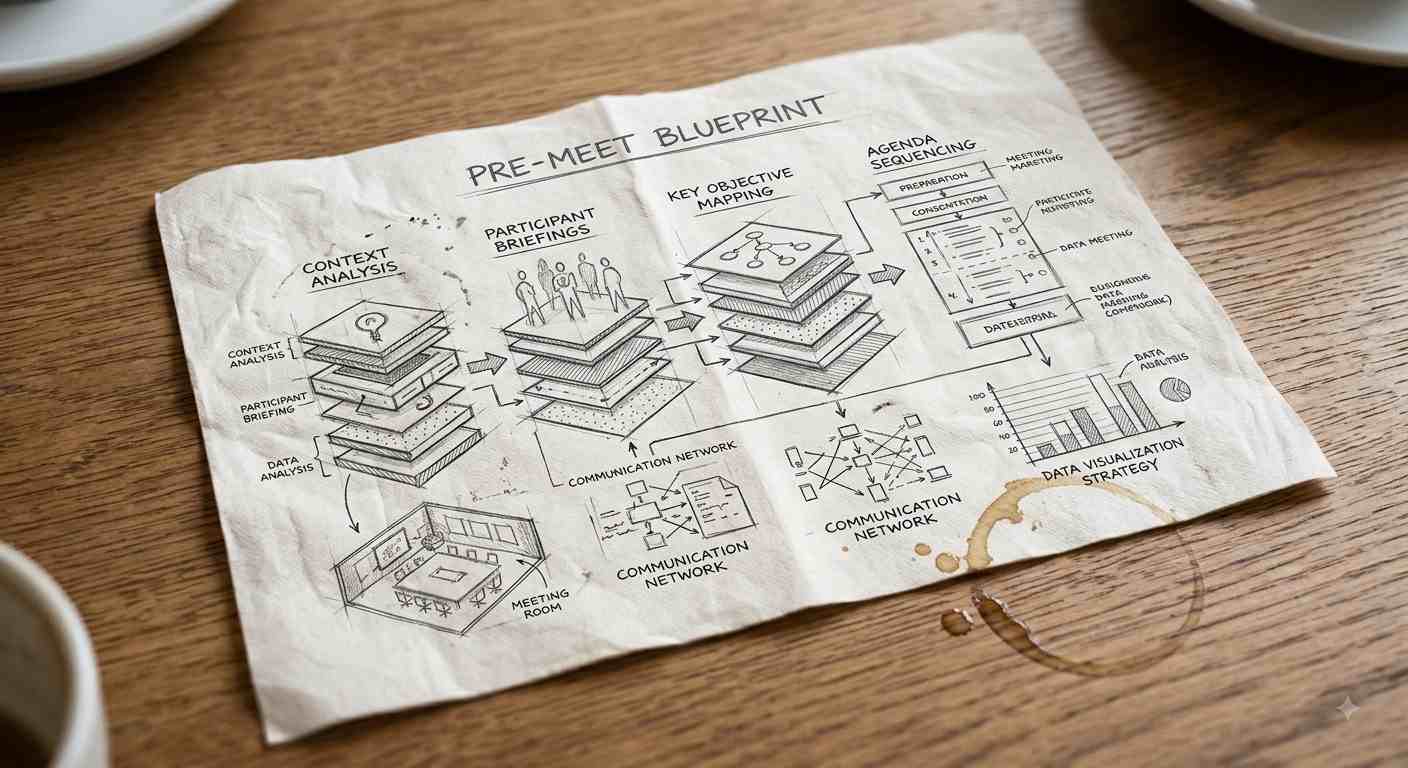
Why Your First Team Meeting Matters More Than You Think
You’ve landed the job, congratulations! Now comes the real work. Many new managers, eager to hit the ground running, dive headfirst into operations, strategy, or even making immediate changes. They might see their first team meeting as a simple “meet and greet.” But this perspective misses a critical point: your team is observing everything. They’re wondering what kind of leader you’ll be, if you’ll support them, whether their jobs are safe, and if you understand their world. Your initial interactions are loaded with significance, shaping perceptions and establishing the psychological contract for your entire tenure.
Research from sources like Harvard Business Review consistently highlights that effective onboarding for managers isn’t just about learning company policies; it’s fundamentally about building relationships and understanding the cultural landscape. Your first team meeting is your grand opening. It’s where you start to define your leadership brand. A poorly managed first meeting can breed anxiety, confusion, or even resentment. A well-prepared one, however, can inspire confidence, foster psychological safety, and energize your team, setting a positive trajectory for your `new manager 30 60 90 day plan`. The Pre-Meet Blueprint is your navigational chart for this crucial first voyage. It’s a structured approach for new managers facing their initial team engagement, ensuring you walk in prepared, confident, and ready to lead.
The Pre-Meet Blueprint: Your 5 Essential Steps
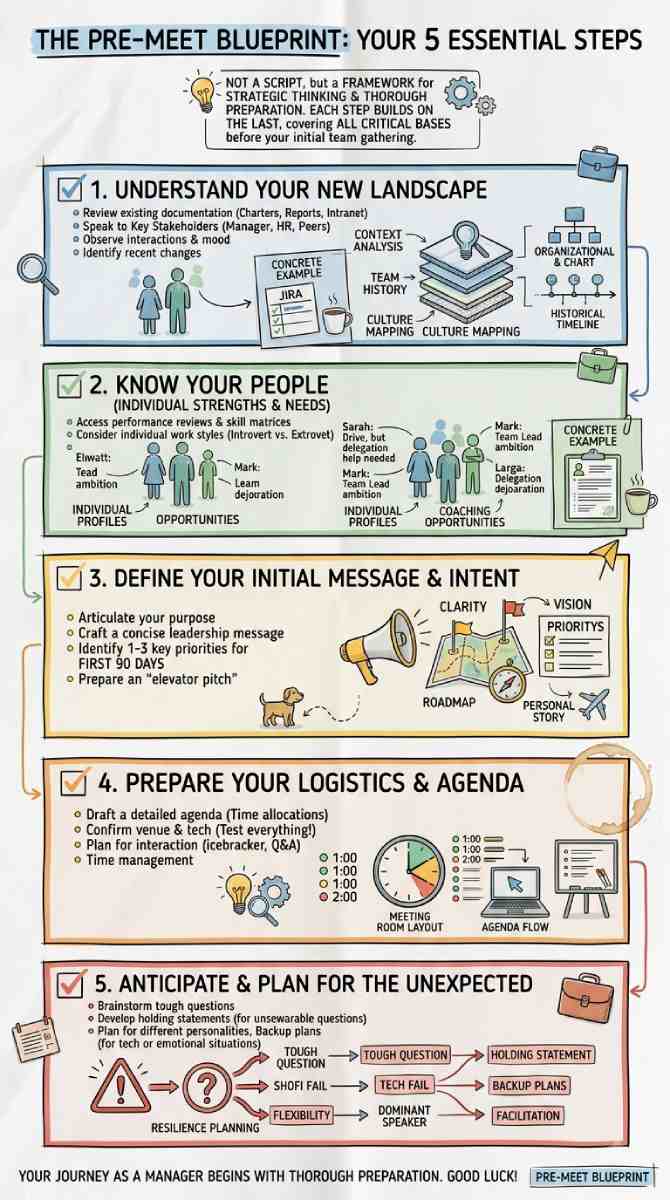
This framework isn’t about memorizing a script; it’s about strategic thinking and thorough preparation. Each step builds on the last, ensuring you cover all critical bases before your initial team gathering.
1. Understand Your New Landscape (Context & Culture)
Before you can lead a team, you need to understand the environment they operate within. This isn’t just about the business goals; it’s about the team’s history, its current dynamics, and the unwritten rules that govern daily life. Think of yourself as an anthropologist observing a new culture.
What to do:
- Review existing documentation: Look at team charters, past project reports, company intranet pages, performance metrics, and any organizational charts.
- Talk to key stakeholders (discreetly):Connect with your own manager, HR partners, peers who work closely with the team, or even the previous manager (if appropriate and available). Ask about the team’s strengths, current challenges, key personalities, and what works well versus what needs improvement.
- Observe and listen: If possible, spend some informal time in the team’s vicinity before the meeting. Notice how people interact, who talks to whom, and the general mood.
- Identify recent changes:** Has the team just gone through a difficult period (e.g., layoffs, a failed project, a change in leadership)? This context is vital.
Concrete Example:
Let’s say you’re taking over a software development team. Before your first meeting, you’d review their JIRA boards to see project velocity and backlogs. You’d chat with the head of product about recent releases and any technical debt. You’d also speak with an HR business partner about team morale data or any historical conflict resolution. You might learn the team recently missed a major deadline, leading to low morale and some blame-shifting. This insight immediately informs you that your `first week as a manager` needs to address psychological safety and team cohesion, rather than solely focusing on new targets.
2. Know Your People (Individual Strengths & Needs)
While a team is a collective, it’s composed of individuals, each with unique skills, aspirations, and communication preferences. Understanding these nuances helps you tailor your approach and show genuine interest.
What to do:
- Access performance reviews & skill matrices: With HR guidance, review available performance data. Look for individual strengths, development areas, career aspirations, and any specialized skills.
- Consider individual work styles:Are there introverts or extroverts? Detail-oriented individuals or big-picture thinkers? Understanding these dynamics can help you structure interactions.
- Prepare for initial 1:1s (even if after the first team meet):** Jot down specific questions you want to ask each team member in your first individual conversations. This shows you’ve thought about them as individuals.
Concrete Example:
For your new sales team, you receive their last two performance reviews. You notice Sarah consistently exceeds targets but struggles with delegation, preferring to do everything herself. Mark is a consistent performer but has expressed interest in moving into a team lead role. By knowing this *before* the first team meeting, you’re not just seeing a list of names; you’re seeing individuals with potential and specific coaching opportunities. You might internally note to praise Sarah’s drive but also consider how to gently introduce the concept of leveraging team resources. For Mark, you’d ensure your message about career growth resonates.
3. Define Your Initial Message & Intent (Clarity & Vision)
What do you want your team to walk away with after that first meeting? What’s your leadership philosophy, and what are your immediate priorities? Clarity here is paramount to building trust and setting expectations.
What to do:
- Articulate your purpose: Why are you here? What value do you intend to bring?
- Develop your initial message: Craft a concise statement about your leadership philosophy, your commitment to the team, and what they can expect from you (and what you expect from them).
- Identify 1-3 key priorities for the `first 90 days as a new manager`: Be clear about what you’ll be focusing on initially. Avoid overwhelming them with a long list.
- Prepare an “elevator pitch” of yourself:Who are you outside of work? What’s a fun fact? This helps humanize you.
Concrete Example:
You’ve just been promoted to lead the customer success team. Your initial message might be: “My priority in these `first 90 days as a new manager` is to listen and learn from each of you, understand our current customer experience strengths and challenges, and ensure you all feel supported in your roles. My door is always open for honest feedback, and I believe in empowering each of you to deliver exceptional service.” You might also share a brief, lighthearted story about your dog or a recent travel adventure to break the ice.
4. Prepare Your Logistics & Agenda (Structure & Control)
A well-structured meeting feels organized and professional, immediately signaling your competence. Don’t leave anything to chance, especially when you’re establishing yourself.
What to do:
- Draft a detailed agenda: List topics, time allocations, and who is responsible for each segment (even if it’s just you).
- Confirm venue & tech: Book the room, test projectors, video conferencing software, and ensure whiteboards/markers are available. Nothing derails a `first week as a manager` like technical glitches.
- Plan for interaction: Will you have an icebreaker? How will you facilitate Q&A? Will there be breakout discussions?
- Time management: Ensure the meeting starts and ends on time. Respecting their time shows respect for them.
Concrete Example:
Your agenda for a 60-minute meeting might look like this:
- (5 min) Welcome & Introductions (briefly about you)
- (10 min) Your Leadership Philosophy & Initial Priorities
- (20 min) Team Round Robin: “One recent success and one burning question you have for me”
- (15 min) Open Q&A
- (5 min) Next Steps: Schedule 1:1s, follow-up actions
- (5 min) Wrap-up & Thank You
You’d send this agenda beforehand, ensuring the meeting room is set up with water, and you’ve tested the screen share for your one slide introduction.
5. Anticipate & Plan for the Unexpected (Flexibility & Resilience)
Even with the best preparation, things can go off-script. Preparing for potential challenges allows you to remain calm, confident, and responsive, demonstrating genuine leadership.
What to do:
- Brainstorm tough questions: What are the most difficult or cynical questions your team might ask? (e.g., “Are there layoffs coming?”, “Why did the previous manager leave?”, “Are you going to change everything?”)
- Develop holding statements: You don’t need all the answers, but you need a professional way to respond. (e.g., “That’s a valid question, and something I’m actively looking into. I’ll get back to you with more clarity by [date].”)
- Plan for different personalities: How will you handle a dominant personality who monopolizes conversation? Or someone who is completely silent?
- Backup plans:** What if the tech fails? What if someone gets emotional?
Concrete Example:
You anticipate a team member might ask about a recent unpopular company policy change that impacted their workload. Your planned response isn’t to defend the policy, but to acknowledge their concern: “I understand that the recent policy change has created some challenges. While I can’t undo it, I want to work with you to understand its impact on our team’s workflow and explore ways to mitigate negative effects. That’s a great discussion point for our upcoming 1:1s.” You also have a plan for the quietest team member: you might direct a specific, open-ended question to them during the round robin to encourage participation, or make a note to follow up with them individually. These `new manager tips` are about proactive problem-solving.

Putting It All Together: A Mini Case Study
Let’s imagine you’re Sarah, a new manager promoted internally to lead the content marketing team you’ve been a part of for three years. This presents unique challenges, as you’re now leading former peers. Your first team meeting is scheduled for next Tuesday.
1. Understand Your New Landscape:
Sarah talks to her previous manager (now her director) about the team’s strengths (creative, fast) and weaknesses (occasionally inconsistent voice, struggles with cross-departmental collaboration). She reviews recent project post-mortems and notes a recurring issue with designers not getting content early enough. This tells her `first week as a manager` needs to focus on process improvement and inter-team communication.
2. Know Your People
Sarah accesses performance reviews for her team. She notes that David is an exceptional writer but resists process changes, while Emily is a rising star keen on taking on more leadership. Knowing this, Sarah plans to highlight collaboration in her initial message and consider how to involve Emily in future initiatives.
3. Define Your Initial Message & Intent
Sarah decides her core message will be about fostering a culture of continuous improvement and amplifying the team’s unique voice. Her priorities for the `first 90 days as a new manager` are: 1) Streamlining the content creation workflow with design, and 2) Identifying opportunities for skill development within the team. She plans to share a brief anecdote about her passion for storytelling to connect personally.
4. Prepare Your Logistics & Agenda
Sarah books a comfortable meeting room, sends out an agenda that includes a “Two Truths and a Lie” icebreaker (since they know each other, but it’s a new dynamic), time for her intro, discussion of initial priorities, and a robust Q&A session. She also includes a clear next step: scheduling 1:1 meetings with each team member.
5. Anticipate & Plan for the Unexpected:
Sarah anticipates questions about potential changes to current projects or specific individual responsibilities. She prepares a holding statement like, “I’m still getting my bearings on some of these specifics, but I’m committed to transparent communication, and we’ll discuss these in our 1:1s and as a team to ensure a smooth transition.” She also considers how to address David’s potential resistance to new processes, planning to emphasize “experimentation” rather than “mandate” when discussing workflow changes.
By following this blueprint, Sarah walks into her first meeting not just as a former peer, but as a confident, prepared leader ready to guide her team forward.
Adapting the Blueprint: From Junior to Executive
The Pre-Meet Blueprint is highly adaptable. While the core steps remain, the depth and focus will shift based on your seniority and the organizational context.
- Entry-Level/Team Lead
Your focus will be more granular. In “Understand Your New Landscape,” you might focus more on immediate team-level processes and internal dynamics rather than company-wide strategy. “Know Your People” will involve closer attention to individual task performance and specific skill gaps. Your “Initial Message” might be more about support and learning together. The scale of your `new manager 30 60 90 day plan` will be smaller.
- Mid-Level Manager
You’ll balance team-level focus with cross-functional awareness. “Understanding Your New Landscape” expands to include peer relationships and how your team interacts with others. “Know Your People” still involves individual assessment but also identifying potential team leaders and future succession planning. Your “Initial Message” will likely include strategic alignment with departmental goals.
- Senior Leader/Executive
Your blueprint will be far more strategic. “Understand Your New Landscape” involves deep dives into market trends, competitive analysis, and stakeholder mapping across the entire organization. “Know Your People” extends to assessing leadership capabilities across multiple teams and identifying key strategic hires. Your “Initial Message” will be about vision, organizational culture, and significant strategic shifts, often touching upon the `first 90 days as a new manager` for the broader organization. Anticipating questions will involve higher-level concerns about investment, risk, and long-term impact.
Regardless of your level, the essence remains: preparation builds confidence, reduces anxiety, and sets you up for success.
Your first team meeting is a powerful opportunity to define your leadership and ignite your team’s potential. Don’t leave it to chance. By systematically applying the Pre-Meet Blueprint, you’ll walk into that room with clarity, purpose, and the confidence that comes from being truly prepared. This structured approach, a cornerstone of solid `new manager tips`, will not only help you navigate your `first week as a manager` but will also serve as a foundation for your entire `new manager 30 60 90 day plan`.
To help you put this framework into action, we’ve created a comprehensive, downloadable checklist version of the Pre-Meet Blueprint. Grab your copy today and ensure your first team meeting is a resounding success!